The best Thai trips unfold like a well-paced menu: a gentle start in the hills, a few contrasting courses, and a finale by the sea. This route runs from north to south, pairing five memorable places to stay or eat with the feeling that luxury here is measured in care and flavor rather than spectacle.
Chiang Mai: Privacy in the North
Begin at Thantara Resort Chiang Mai, where the villas are spacious, thoughtfully designed and wonderfully private. Breakfast arrives floating on the surface of your own pool, and dinner can be a Thai barbecue prepared in the villa. At the resort restaurant, the northern classic khao soi shares a menu with well-executed Western dishes, so every palate is looked after.
The city around the resort has a long memory. Chiang Mai was founded in 1296 by King Mangrai, and its name means new city. The old center is a square of roughly 1.6 kilometers on each side, bordered by a moat and by the remnants of ancient red brick walls. Doi Suthep rises to the northwest, with Wat Phra That Doi Suthep near its summit at about 1,073 meters, and the city itself sits in a broad basin at around 300 meters, which keeps January nights pleasantly cool, with an average low near 15.7 degrees Celsius against a daytime high of about 30.
Khao soi, the dish that appears on the resort menu, is worth understanding. It is a curry noodle soup from Northern Thailand, made with a thin, coconut milk broth and usually served with chicken or beef, then topped with crispy fried egg noodles, pickled mustard greens, shallots, lime and chilies fried in oil. It is believed to have arrived with Chin Haw Muslim traders along the spice route, and it is one of the north’s most beloved bowls.
Hua Hin: Seaside Style
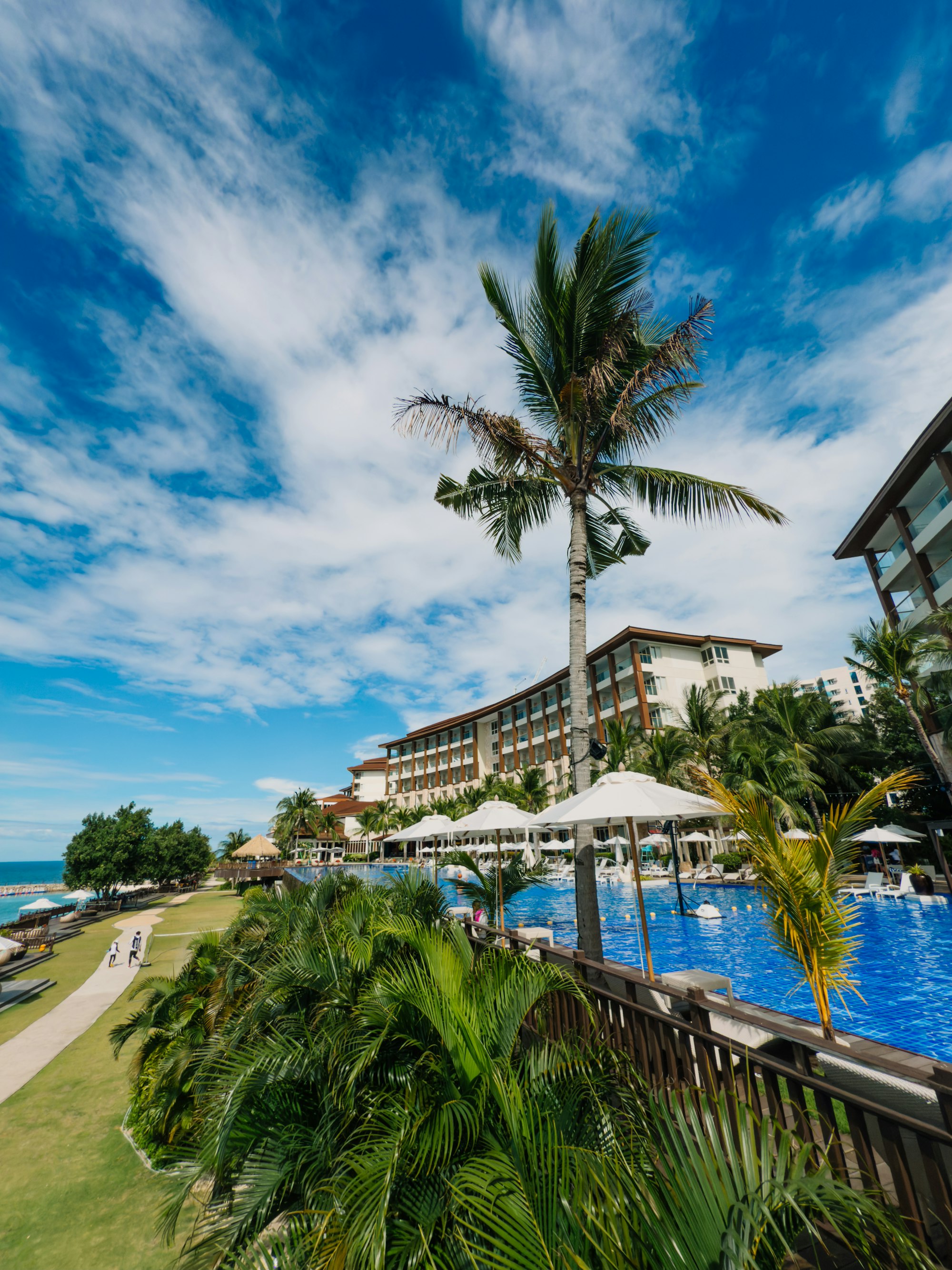
Head to the coast and The Standard, Hua Hin, a design-forward address in one of Thailand’s historic seaside towns. Days revolve around the beach, the pool and lively social spaces, and the mood stays relaxed yet stylish.
The town’s history explains its polish. Hua Hin was settled in 1834 by farmers displaced by drought, then transformed by the arrival of the Southern Railway in 1911, which opened the coast to Siam’s aristocracy. King Rama VII completed the summer palace Klai Kangwon, whose name means Far from Worries, in 1929. Today it sits along the Gulf of Thailand, about 199 kilometers by road from Bangkok, and its shallow waters are a favorite with families.
Bangkok: A Hidden Japanese Table
In the capital, Tokyoxxx Premium Japanese Restaurant sits on Soi Sukhumvit 23 behind an unassuming entrance. Inside, the atmosphere is warm and intimate, made for long dinners, and the Japanese cooking is carefully prepared with high-quality ingredients.
Sukhumvit is one of the capital’s major roads, running southeast through the Watthana and Khlong Toei districts and lined with hotels, retail outlets and upmarket housing in its side streets. Bangkok itself was made the capital on 21 April 1782, when King Rama I moved the seat of government to Rattanakosin Island on the eastern bank of the Chao Phraya River, and its official name, Krung Thep Maha Nakhon, is commonly shortened to Krung Thep.
Koh Samet: Villa Seclusion
Mahina Villa Resort is described as the finest villa on Koh Samet, with exceptional privacy and elegant design. Breakfast is served in bed, a fire show lights up each evening, and Whiteshark speedboats carry guests between the pier in Rayong and the island, transfers that are included in the stay.
Koh Samet lies in the Gulf of Thailand off Rayong Province, about 220 kilometers southeast of Bangkok. The island is small, roughly seven kilometers from north to south and four from west to east, and most of it forms part of Khao Laem Ya-Mu Ko Samet National Park. Its longest beach, Hat Sai Kaeo, has a name that translates as Glass Sand Beach.
Phuket: A Finale in the Old Town
Finish at Num Num Phuket, in the heart of Phuket Old Town among heritage streets and colorful architecture. The cooking leans Turkish and Mediterranean, with local favorites and inventive fusion dishes alongside. The mantı is the standout, said to rival versions found in Istanbul, and outdoor seating is arranged for lingering meals. A new menu has recently arrived, which makes a return visit easy to justify.
Old Phuket Town includes the streets around Thalang, Dibuk, Yaowarat, Phang Nga and Krabi Roads, an area known for its Sino-Portuguese architecture. Phuket is Thailand’s largest island, a landscape of about 543 square kilometers in the Andaman Sea. Mantı, for its part, is a Turkish dish of folded dough triangles filled with minced meat, typically served with garlic yogurt, melted butter or olive oil, and spices such as sumac and red pepper, with the town of Kayseri especially known for it.
Why This Route Works
Each stop offers a different rhythm: hillside seclusion, seaside leisure, city discretion, island drama and old-town warmth. Together they show how varied Thailand can be within a single journey, and how consistently the country delivers hospitality that feels personal. Pricing and booking details were not available for these places, so confirm rates and availability directly before planning dates.
The variety at the table reflects the same range. Thai cuisine is often described as five regional cuisines, matching the country’s five main regions, and meals are built around shared dishes served together with rice at the center. Lemongrass, galangal and kaffir lime leaves supply much of the fragrance, and the balance of sweet, sour, salty and spicy is the unifying principle from the northern hills to the southern shore.