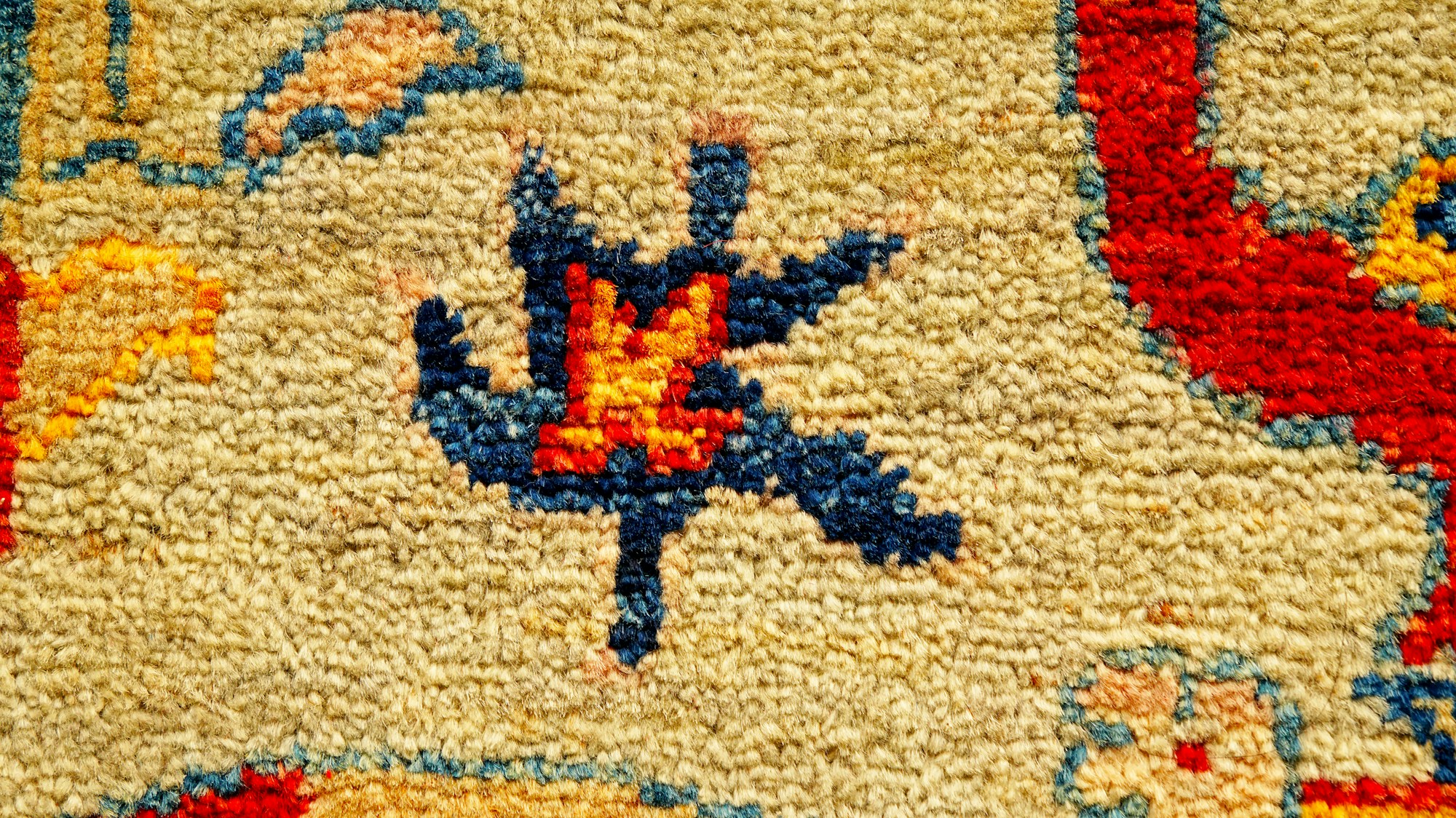
In a small whitewashed town in the Alentejo, women have been stitching wool into linen for more than three centuries. The result is the Arraiolos rug, one of Portugal’s most recognizable crafts and a quiet signature of Portuguese interiors, from country manor houses to contemporary city apartments. Unlike woven or knotted carpets, an Arraiolos rug is embroidered by hand, stitch by stitch, onto a backing fabric.
A Craft With Deep Roots
The tradition takes its name from Arraiolos, a hilltop town crowned by a circular medieval castle, about twenty minutes from Évora. Historians link its origins to the influence of Persian and Moorish carpets, adapted by local artisans from at least the seventeenth century. Over time the designs absorbed Portuguese motifs: flowers, birds, trees of life and the curling borders seen in tiles and baroque decoration. The craft became so closely tied to the town that it is now protected by certification, which guarantees origin and method.
How an Arraiolos Rug Is Made
The work begins with a design drawn onto a canvas of linen or jute. The artisan then fills it with pure wool using the distinctive Arraiolos stitch, a slanted, crossed stitch that creates a dense, slightly braided surface. Each color is worked area by area, following the pattern. Depending on the size and complexity, a single rug can take weeks or even months to complete. Natural wool, often dyed in rich blues, ochres, terracottas and greens, gives the finished piece its warmth and longevity.
Recognizing Quality
A well-made Arraiolos rug has tight, even stitches with no gaps where the backing shows through. The density of stitches per square decimeter is one measure of quality: the finer the canvas, the more stitches, the more detail and the more hours of work. Turn the rug over and the back should be neat and consistent. Authentic pieces from the town carry a certification label, and reputable workshops will happily explain the materials, the stitch count and who made the piece.
Visiting Arraiolos
The town makes a rewarding half-day trip from Évora. Several workshops welcome visitors, and it is often possible to watch embroiderers at work and see rugs in progress on the frame. The town’s interpretation center dedicated to the rug tells the story of the craft through historic pieces and patterns. Afterward, walk up to the castle for wide views over the plains of the Alentejo, where cork oaks and olive groves stretch to the horizon.
Commissioning Your Own
One of the great luxuries of Arraiolos is the chance to commission a rug made to measure. Many workshops will adapt a traditional design to your colors and dimensions, or create something entirely new. Expect to wait several months and to pay according to size and stitch density. The reward is a piece that is truly yours, made by hand in the place where the craft was born, and built to last for generations.
Living With Arraiolos
Traditional floral patterns bring warmth to classic interiors, while simpler geometric or monochrome designs suit contemporary spaces surprisingly well. Arraiolos rugs are durable but appreciate care: regular gentle vacuuming without a beater bar, rotation to even out wear and professional cleaning when needed. Treated well, a rug stitched today will still be telling its story in a Portuguese home many decades from now.