
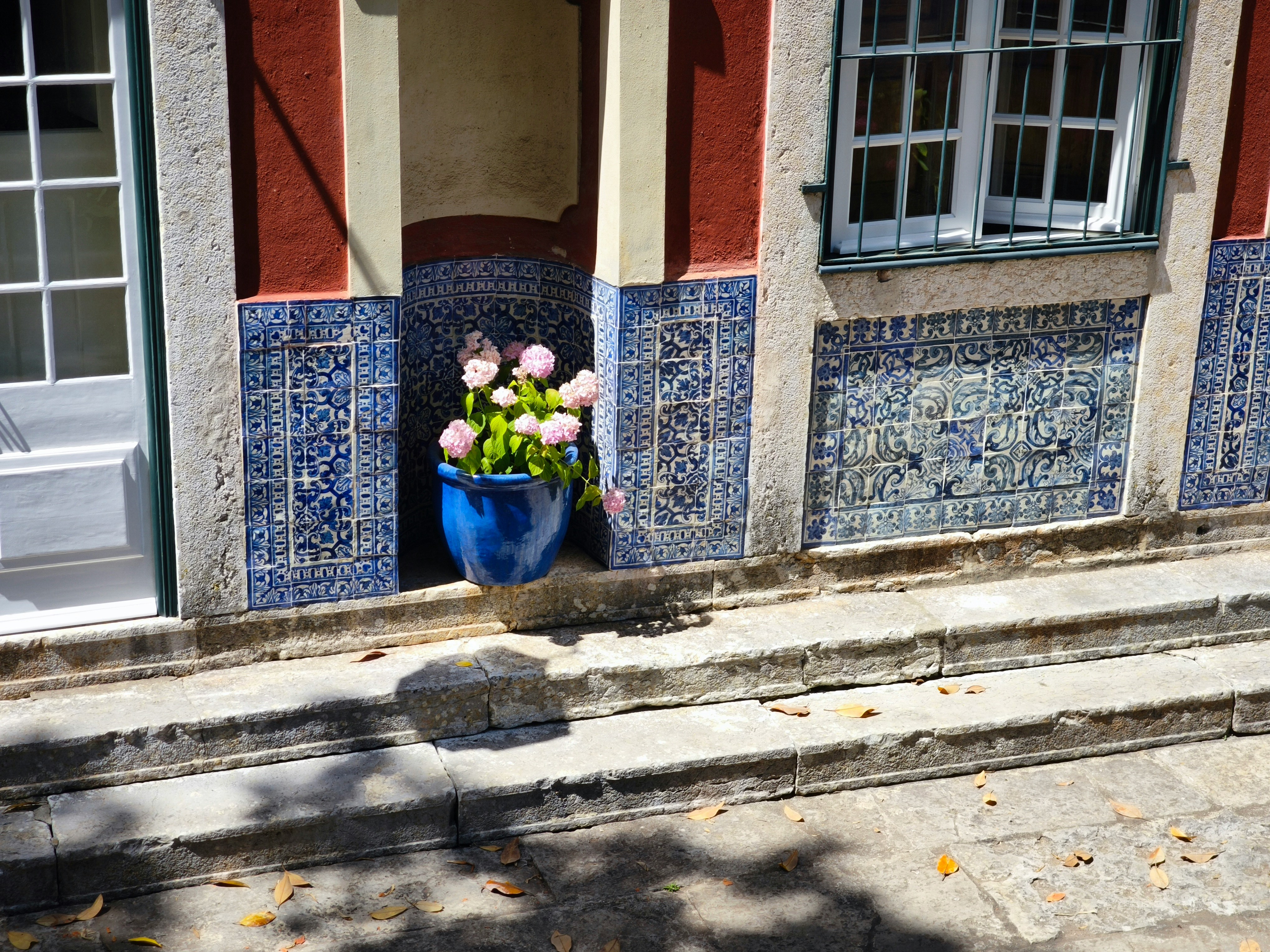
Walk through any Portuguese town and your eyes will land on tiles: blue and white panels in a church, a green and yellow facade on a quiet street, a station platform lined with painted scenes. These are azulejos, the glazed ceramic tiles that have decorated Portugal for centuries. This guide to Portuguese azulejos explains where the tradition comes from, how the tiles are made, and where to see and learn about them, from the Museu Nacional do Azulejo in Lisbon to the historic factories that still paint them by hand.
What Is an Azulejo?
“Azulejo” is the Portuguese word for a wall tile. The tradition arrived with the Moors, who introduced decorated tiles to the Iberian Peninsula in the thirteenth century, though production in Portugal became widespread only in the 1500s. The geometric patterns seen in early collections reflect those Islamic origins. Over time, Portuguese artisans developed their own language: narrative panels with battles, biblical scenes and landscapes, as well as repeating patterns designed for entire walls.
How Azulejos Moved Outdoors
For a long time azulejos were mostly an interior decoration. After the 1755 earthquake, as Lisbon was rebuilt, they began to appear on building exteriors. Their resistance to weather and relatively low cost made them an excellent facade covering, and by the nineteenth century they were a defining feature of Portuguese streets. The floral Pombaline pattern, named after the Marquis of Pombal who led the reconstruction, could be produced quickly and affordably, helping the city rise again. Regional styles developed too, with tiles in Porto and the north often featuring relief work.
The Museu Nacional do Azulejo in Lisbon
The most rewarding place to understand the art form is the Museu Nacional do Azulejo, housed in an early sixteenth-century convent. Its collection spans five centuries, and one highlight is a panoramic panel, about 72 feet wide, showing Lisbon as it looked before the 1755 earthquake. Allow time for a slow visit: the tiles are best appreciated up close, where you can see the brushwork and the glaze.
Historic Factories Still Painting by Hand
Portugal’s azulejo tradition is not only in museums. Fábrica Sant’Anna in Lisbon, founded in 1741, has artisans who paint designs by hand onto white ceramic squares at long tables, working in roughly the same way as since its founding. The factory also restores tiles it made for overseas sites, including São Francisco in Salvador, Brazil, and the Bank of Angola in Luanda. Fábrica Viúva Lamego, around 170 years old, made most of the tiles for Lisbon’s metro stations. Maria Keil designed the first stations, and the factory has hosted artists in residence, among them Manuel Cargaleiro. Visits and workshops vary, so check with each factory before planning a stop.
Reading the Tiles on the Street
Part of the pleasure of Portugal is simply looking up. In Lisbon, facades in blue, white, green and ochre catch the light differently through the day. Tiles have also moved into the modern city: the metro stations mentioned above make contemporary art part of the daily commute, with Brazilian contemporary design influencing mid-twentieth-century work. Take a few photographs, but be mindful: protective laws and awareness campaigns now guard against the removal of historic tiles, so please admire them where they belong.
A Short Azulejo Route in Lisbon
Turismo de Lisboa promotes an azulejo route that links places where the tiles can be seen in the city. For a simple plan, begin at the Museu Nacional do Azulejo, spend the middle of the day walking through the historic neighborhoods to look at facades, and end the afternoon in a metro station to see the twentieth-century tiles of Maria Keil and her successors. The route moves from a convent to the street to the underground, and it shows how the same craft has adapted across five centuries. Take your time, carry a small notebook if you like to sketch, and let the patterns guide where you turn.
Why the Craft Endures
Part of the azulejo’s endurance is its practicality: a glazed tile is durable, easy to clean and beautiful in sunlight. Part of it is cultural, since tiles carry stories, from naval scenes to quiet pastoral images, that connect a building to its history. The tradition survives because people continue to paint, restore and cherish it, and because visitors continue to stop, look up and ask how it was made.
Bringing Azulejo Home
For travelers who want a keepsake, the thoughtful choice is a hand-painted tile or a signed piece from a reputable workshop, rather than a mass-produced souvenir. Ask about the maker, the painting method and the origin of the clay and glaze. A single well-chosen tile carries a small piece of Portuguese craft, and it makes an elegant gift for a kitchen, a hallway or a bookshelf.
A Living Tradition
The azulejo remains one of Portugal’s most recognizable cultural signatures, equal parts architecture, art and daily life. Whether you meet it in a convent museum, on a corner facade or at a painter’s table, it rewards patience and curiosity. As always, please confirm opening hours and visiting arrangements with each venue before you go.


