
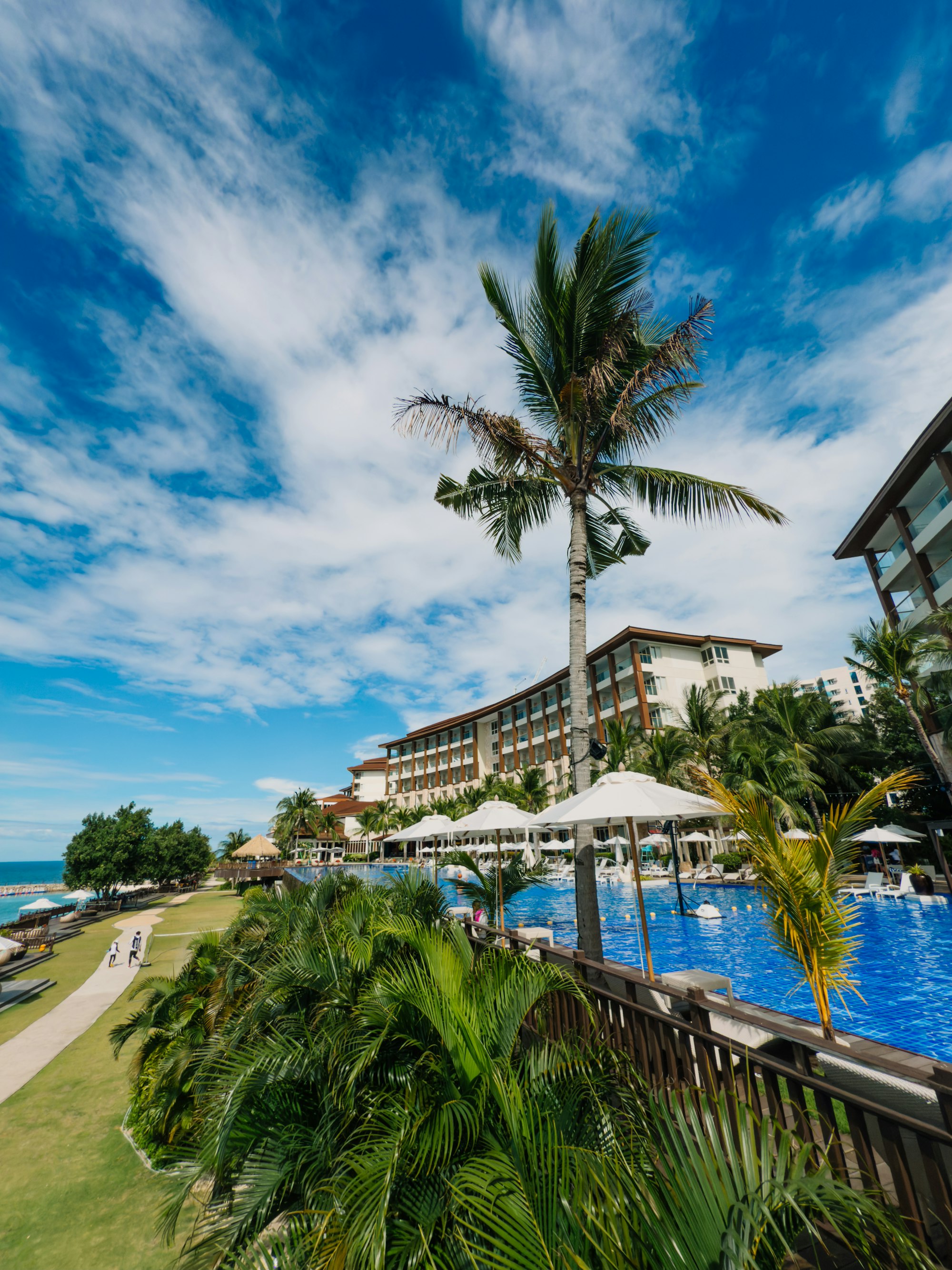
Some hotels announce themselves with scale. The five below do the opposite: each earns its place through a clear point of view, a sense of place and a kitchen worth planning a trip around. Here is where to look across Southeast Asia in 2026.
Amatara, Phuket: Teak, Water and Slow Evenings
On the quiet curve of Cape Panwa, Amatara in Phuket is built around the sound of water against stone, teak architecture and light that settles gently across open spaces. The mood is unhurried, best summed up by a sunset drink beside the bay. At the Siri restaurant, the Tom Kha Gai is the dish to order.
The island setting adds to the appeal. Phuket is Thailand’s largest island, covering roughly 543 square kilometers off the west coast in the Andaman Sea, and the Sarasin Bridge links it to Phang Nga province on the mainland. In Old Phuket Town, the streets around Thalang, Dibuk, Yaowarat, Phang Nga and Krabi Roads are known for their Sino-Portuguese architecture, a lovely contrast to the open, water-facing calm of a bayside stay.
Artyzen, Singapore: Restraint With Warmth
Artyzen in Singapore takes an urban, botanical approach: handwoven fabrics, subtle leaf patterns and a muted palette. Suites are conceived as private sanctuaries that frame the skyline, and the rooftop pool keeps a composed, still atmosphere. Downstairs, Quenino by Victor Liong offers a modern take on Southeast Asian flavors, with Australian mud crab in taro cream and caviar, and Spencer Gulf kingfish with white soy cream and burnt garlic oil. It is a hotel that understands restraint, yet delivers warmth.
Singapore itself has long balanced greenery with urban polish. The Singapore Botanic Gardens, established in 1859, are recognized by UNESCO as an outstanding example of a British tropical colonial botanic garden, one that has been a center for plant research in Southeast Asia since 1875. Around Marina Bay, the downtown rises on land reclaimed between 1954 and 1992, a reminder that this is a city that plans carefully and builds with intent.
Rosewood Phnom Penh: Cambodian Craft at Height
Rosewood Phnom Penh looks out across the layers of the city, historic and modern alike. Inside, contemporary Cambodian craftsmanship takes over: silks, sculptural lighting and warm stone. The steak at its signature restaurant is a point of pride, and Sora Bar is described as ranked 220th among the world’s best bars.
The view has plenty to take in. Phnom Penh sits where the Tonlé Sap and the Mekong meet, and it is where the Bassac River begins. The city was re-established as the national capital in 1865, and the Royal Palace remains the seat of the monarchy. Its nickname, Pearl of Asia, comes from a blend of French colonial, New Khmer and Art Deco architecture, and Sisowath Quay, a strip of about five kilometers along the Tonlé Sap, lines the water with restaurants, bars and hotels.
Hilton Saigon: A City Close but Never Intrusive
In District 1 of Ho Chi Minh City, Hilton Saigon greets guests with a lobby of marble and bronze accents. Rooms are streamlined and comfortable, and many open toward the Saigon River, where boats pass and lights reflect on the water. The kitchen reinterprets Vietnamese flavors, and the overall effect is that the rhythm of the city feels close, yet never intrusive.
The river is central to the city’s geography: the Saigon River is the largest of the waterways and canals that define Ho Chi Minh City. Many still call the city Saigon, a name that remains in everyday use, even though Ho Chi Minh City was adopted as the official name in 1976. French colonial landmarks, including Notre-Dame Cathedral, the Saigon Central Post Office and Ben Thanh Market, give the center a layered, photogenic character. The climate is tropical, with a rainy season from about May to November and a dry season from December to April.
Else, Kuala Lumpur: A Heritage Building With a Curator’s Eye
Else occupies a restored heritage building in a once overlooked corner of a lively Kuala Lumpur district. Ceramics, textiles and lighting are chosen with a curator’s eye, giving the handmade rooms a personal, artistic character: spaces meant for reflection rather than spectacle. The seasonal, creative restaurants are worth a visit, and the Yellow Fin Horse desserts are especially memorable.
Kuala Lumpur has its own story of layers. The city developed from about 1857 around tin mines at the confluence of the Klang and Gombak rivers, and its name is often translated as muddy confluence. Government offices moved into the Sultan Abdul Samad Building in 1897, and today Malays, Chinese and Indians form the city’s three major communities, a mix that helps explain the variety on its tables. The MICHELIN Guide Kuala Lumpur and Penang published its first edition in December 2022, listing 97 restaurants across more than 20 cuisine types.
What They Share
Different countries, different moods, one common thread: each of these addresses lets design and cooking speak quietly rather than loudly. For travelers building a 2026 itinerary across the region, they make a thoughtful shortlist.
Read alongside the cities that surround them, the pattern becomes clearer. Each hotel takes its cue from a specific landscape, whether a bay, a botanical garden, a river confluence or a heritage street, and each translates that setting into materials, flavors and pace. That is a more durable kind of luxury than novelty, and it is the reason these five belong on a watchlist rather than a one-season list.


