Few places on the Portuguese coast reward a slow visit as generously as Lagos. Set in the western Algarve, the old town gathers whitewashed streets, historic churches and a working marina, while just beyond it the headlands break into golden cliffs, sea arches and sheltered coves. This guide sketches an unhurried stay built around the town and its coastline.
The Old Town and Its Walls
Lagos rewards walking. The old town is a tangle of narrow streets, historic buildings and small squares, and its sights sit within easy reach of one another: the Church of Santo António, the Church of Santa Maria, the Governor’s Castle and the remains of the ancient city walls. Early morning, before the cafe terraces fill, is the best moment to wander.
Near the harbor entrance stands the Forte da Ponta da Bandeira, a 17th century fort that once guarded the town against pirates. Today it holds a small chapel, modest historical exhibits and a view over the water that makes the short walk worthwhile.
A Harbor of the Age of Discovery
Lagos has more than two thousand years of history, beginning as a Celtic settlement known as Lacobriga. The Moors later called it Zawaia, and it passed to the Portuguese crown in the 1240s. In the fifteenth century it became a center of Portuguese maritime exploration, and Prince Henry the Navigator is recorded as having spent much of his time here, directing voyages in the caravel, the lateen-rigged ship so well suited to long journeys at sea. From 1576 to 1755 Lagos served as the capital of the Algarve, until the great earthquake and tsunami of 1755 destroyed much of the old town.
Some sixteenth-century walls survive alongside the Governor’s Castle, while many of the buildings date from the seventeenth century onward. The Forte da Ponta da Bandeira was completed between 1679 and 1690, and its sea-facing position is a reminder of how closely the town has always been tied to the water.
Gilded Woodwork at Santo António
Do not leave without stepping inside the Church of Santo António. Its simple facade, with asymmetrical bell towers, dates from 1715, and it contrasts with an interior of gilded wood carving known as talha dourada, eighteenth-century blue and white azulejo tiles and six Baroque paintings of the miracles of Saint Anthony. It is counted among the few buildings that survived the 1755 earthquake.
Ponta da Piedade
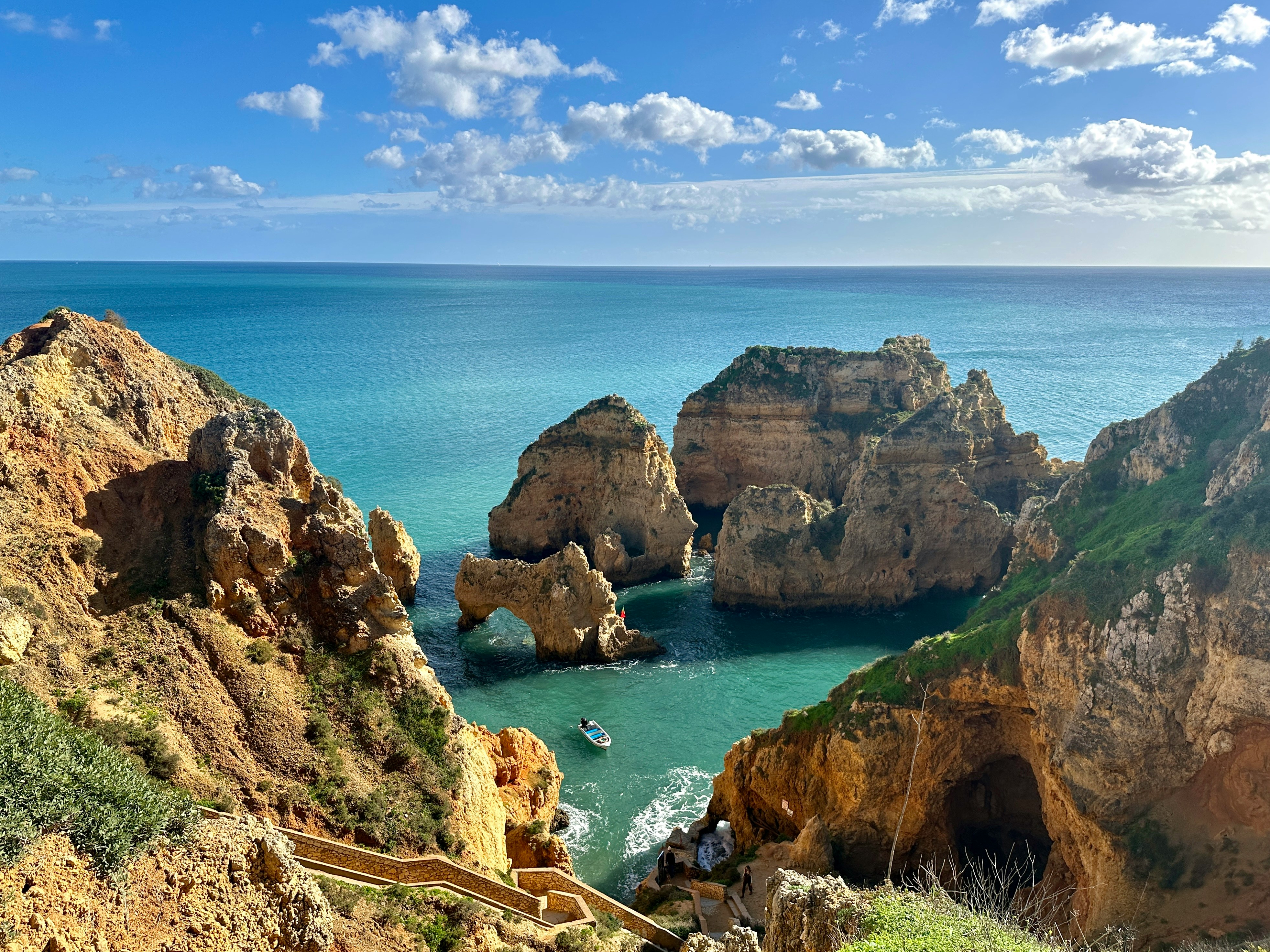
South of town, the headland of Ponta da Piedade is the signature image of this coast. Rock formations, grottoes and sea arches rise from clear Atlantic water, with a lighthouse marking the southernmost point and views reaching toward Alvor, Carvoeiro and Portimão.
There are several ways to see it: a boat tour from the marina, a kayak paddled quietly through the caves, or a walk along the clifftop trails. Calm mornings generally make for the gentlest time on the water, though conditions vary, so ask your operator on the day.
Even for those who prefer to stay on land, the clifftop paths reveal the same coastline from above, with the ochre stone, green water and white surf arranged like a composition. Bring a hat and good shoes, and allow time to pause at the viewpoints rather than hurry between them.
Coves and Beaches
Praia Dona Ana is a sheltered cove between steep cliffs, with golden sand and a wooden staircase leading down from the headland. A little further on, Praia do Camilo is another small cove framed by rock formations, reached by a long flight of steps and rewarded with calm swimming.
For a wider stretch of sand, Meia Praia runs for about four kilometers west of the center, lined with restaurants and beach bars and a short walk from the marina and the train station.
Where to Linger
The marina is the natural hub for boat trips, from dolphin watching to sunset cruises, and its waterfront is lined with restaurants, bars and shops. Lagos also sits comfortably within reach of the wider Algarve, so it works equally well as a base for several days or a graceful stop on a longer journey along the south coast.
Seafood is the obvious order here, and the region’s cataplana, a hinged copper pot of clams, prawns and fish, is a dish worth seeking out at a table with a view.
A Suggested Rhythm for Two Days
Begin the first morning in the old town, taking in the churches and the walls before the heat builds, then lunch near the marina. In the afternoon, take a boat or kayak toward Ponta da Piedade, and end the day at the fort or on the waterfront as the light softens.
On the second day, choose a cove. Praia Dona Ana or Praia do Camilo suit a quiet morning swim, while Meia Praia offers more space and an easy walk back to town. Evenings in Lagos are best kept simple: a seafood dinner, a stroll through the lit streets, and an early night before the next day on the coast.
Shoulder seasons in the Algarve, in spring and autumn, tend to offer gentler crowds and softer light, which suits the unhurried approach this coast rewards.
Opening hours, boat tours and access to beaches can change with the season and the weather. Please confirm details with each venue or operator before you travel.