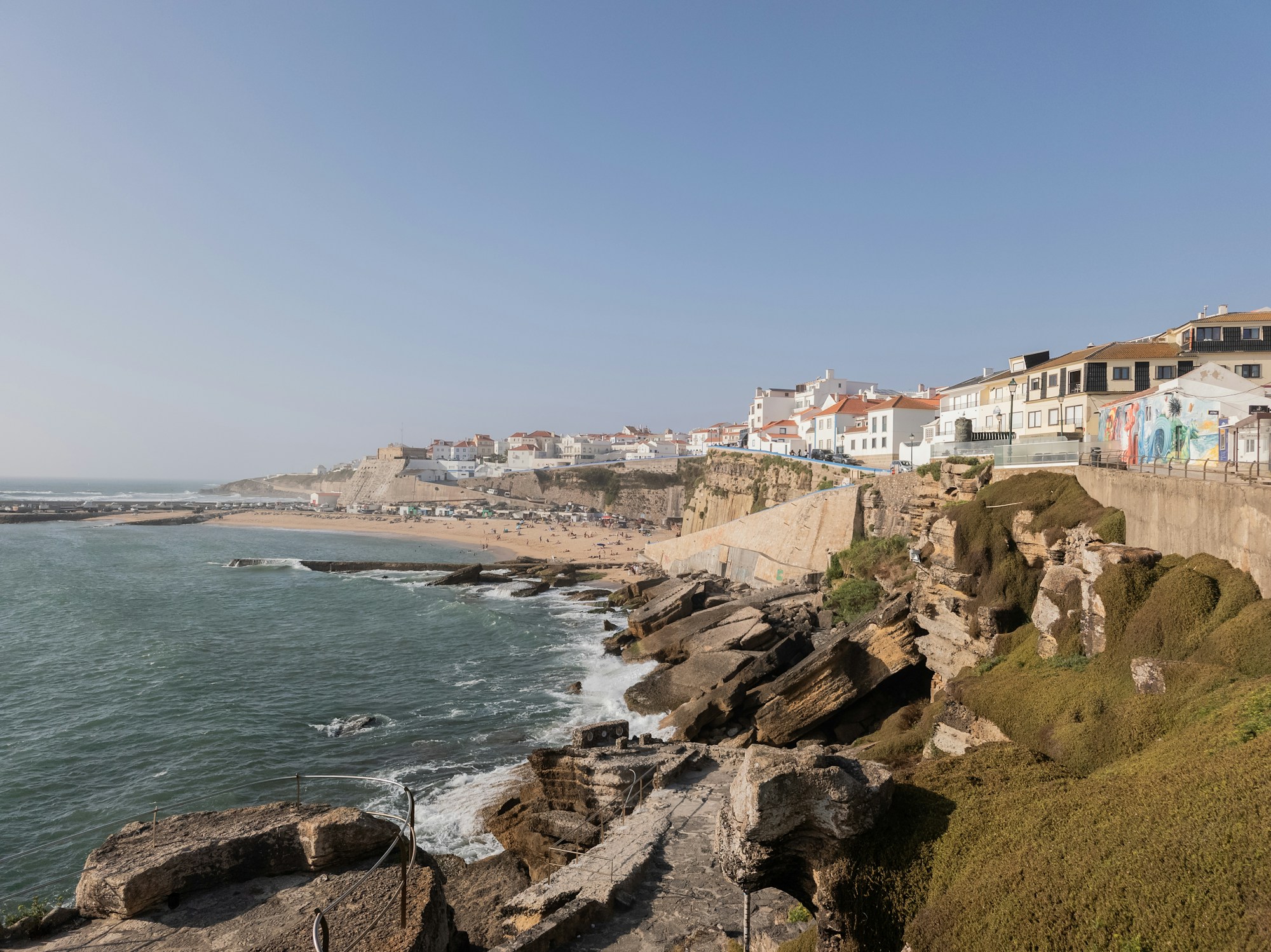

There is a particular kind of light on the Estoril coast, soft, silvery and faintly golden, that seems made for slow days. Just west of Lisbon, where the Tagus opens into the Atlantic, a string of seaside towns has welcomed travelers for generations. Cascais and Estoril, a short walk apart, offer an unhurried alternative to the capital: sheltered coves, graceful promenades, serious museums and tables with an ocean view. This is a day designed to be savored rather than scheduled.
Arriving the Easy Way
The most civilized approach is by train. Services leave Lisbon’s Cais do Sodré station regularly and reach the coast in roughly 40 minutes, with the Atlantic appearing beside the window for much of the ride. Arriving this way sets the right tone: no parking, no hurry, and the sense of leaving the city behind in a single, graceful movement. Step off in Estoril to begin, then let the day travel west toward Cascais.
Estoril: Old-World Glamour
Estoril carries its history lightly. During the Second World War, Portugal’s neutrality drew exiled royals and aristocrats to this stretch of coast, among them King Umberto II of Italy, the Count of Barcelona and Carol II of Romania, and the resort has kept an air of refined theater ever since. At its heart stands Casino Estoril, opened in 1931 and counted among the largest casinos in Europe. It is also an arts and entertainment complex, with an art gallery, bars, restaurants and a performance program, so it rewards a visit even for those who never approach a gaming table. The coast’s mystique has long been linked with the world of Bond, a pleasing piece of lore to carry with you along the seafront.
Take time, too, for the sheltered beachfront between Estoril and Cascais. Praia de Santa Marta, a calm cove within the Sintra-Cascais Natural Park, is a lovely place to pause and watch the water.
The Seaside Walk to Cascais
The connection between the two towns is best made on foot. A seafront promenade links Estoril with Cascais, passing small beaches, the sound of the surf and, in the distance, the masts of the marina. Wear comfortable shoes, carry a light layer for the Atlantic breeze, and allow the walk to take as long as it wishes. Autumn is especially flattering here: the crowds soften, the air is clear, and the afternoon light lingers on the water.
Cascais: Museums, Marina and Atlantic Drama

Opened in 2009, the Casa das Histórias holds paintings, drawings and etchings that span about 50 years of Paula Rego’s career, presented in exhibitions that rotate by theme. The artist chose the architect herself, and his design draws on the region’s historical architecture, especially the nearby palace of Sintra, restated in a contemporary language. Mature trees on the site were kept and woven into the design, so the building sits softly in its garden setting.
From the marina, follow the coast toward Boca do Inferno, the dramatic cliffside formation where Atlantic waves surge into sea caves. Visiting around high tide brings the most spectacle, so a glance at the tide times is time well spent. Further along the coast, Praia do Guincho is a landscape of wind and open sky, beloved by surfers and wind sports enthusiasts, and Cabo da Roca, the westernmost point of continental Europe, makes a memorable extension for those with an extra afternoon.
Cabo da Roca lies within the Sintra-Cascais Natural Park, about 42 kilometers west of Lisbon, where cliffs rise more than 100 meters above the sea. Its lighthouse, in operation since 1772, stands about 165 meters above the Atlantic and was the first purpose-built lighthouse in Portugal. It is a fine place to end an afternoon of wide horizons.
A Royal Summer Address
Cascais wears its elegance with good reason. Long reliant on fishing, sea trade and farming, it was granted town status in 1364. In the nineteenth century, King Luís I made it his summer residence, and from 1870 to 1908 the royal family spent part of each summer here, turning the quiet fishing village into a cosmopolitan address. Noble families followed and built summer mansions along the coast. In 1878 the king had the Citadel equipped with the country’s first electric lights, a detail that adds a quiet glow to an evening walk past its walls.
An Evening Pace
As the day softens, return to the water. A table near the marina or along the seafront is the natural place to linger over fresh fish, a glass of Portuguese white and the changing color of the sky. Then there is the easy way home: the train back to Lisbon, with the coast glowing behind you. It is, quite simply, one of the most elegant day trips Portugal has to give.
Opening hours, ticketing and details can change, so please confirm directly with each venue before you go.