Few destinations have staged their cultural ambitions as deliberately as Abu Dhabi. On Saadiyat Island, a short drive from the center of the capital, a cluster of museums designed by celebrated architects is turning a stretch of coastline into one of the Gulf’s most rewarding places to spend several days with art, architecture and the sea. This winter, the district adds a landmark chapter, and it is a fine moment to begin planning a visit.
The island lies about 500 meters off the coast, roughly a five-minute drive from downtown Abu Dhabi, 20 minutes from the international airport and an hour from Dubai. The Cultural District occupies its western end, a compact 2.43 square kilometers, which makes the museums easy to combine within a single stay.
The Louvre, Beneath a Dome of Light
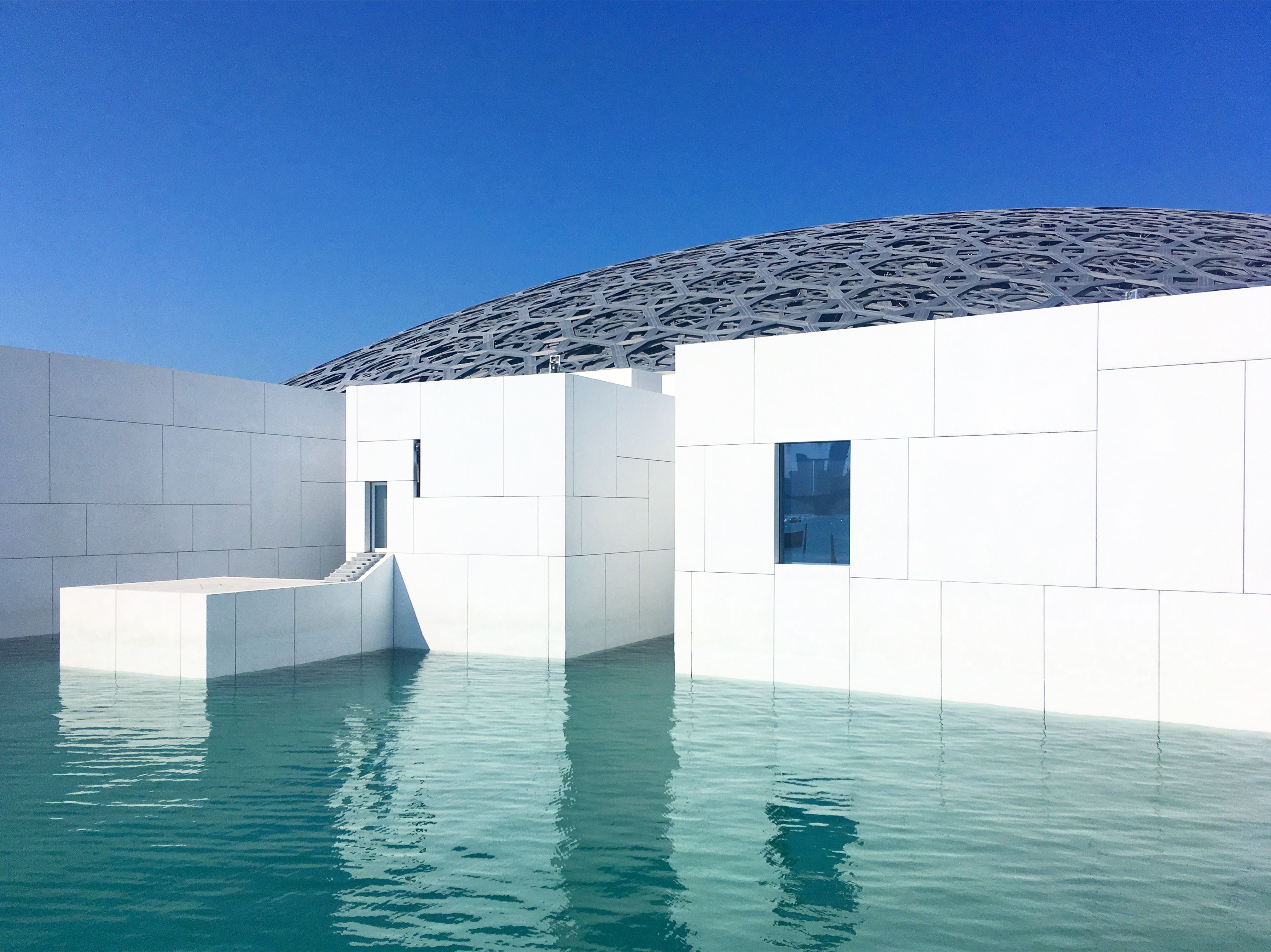
Louvre Abu Dhabi, designed by Jean Nouvel, remains the emblem of the district. Its wide, latticed dome filters the sun into a slow, shifting pattern across the galleries and the water below, an effect best appreciated by lingering rather than hurrying. Allow a generous visit, and consider arriving later in the day, when the light softens and the courtyards feel at their quietest. The museum rewards a second, shorter visit just as well as a first long one.
The museum opened to the public in November 2017. The dome is composed of 7,850 aluminum stars of varying sizes, tessellated over eight layers, which is what filters the sunlight into its shifting pattern. Beneath it, the complex is made up of 55 buildings, 23 of them galleries, and a watertight basement and tidal pools create the impression of a museum standing in the sea.
The collection ranges widely. Among the works associated with the museum are a 14th-century Mamluk Quran, Bellini’s Virgin and Child, Gauguin’s Breton Boys Wrestling from 1888, Mondrian’s Composition with blue, red, yellow and black from 1922, and Magritte’s The Subjugated Reader from 1928. The galleries reward unhurried comparison, one room at a time.
A Gehry Opening in December
The Department of Culture and Tourism Abu Dhabi has announced that Guggenheim Abu Dhabi will open its doors on 11 December 2026. The museum was designed by Frank Gehry, the late Pritzker Prize laureate, and it is expected to be one of the defining architectural moments of the Gulf this season. For travelers, the date offers a natural anchor: a long weekend built around the district, with the newest building as its finale. Opening arrangements, ticketing and visiting hours are best confirmed with the museum directly.
Gehry’s design draws on traditional Middle Eastern covered courtyards and wind towers, which have long cooled buildings in the desert sun. Clusters of galleries of different sizes are linked by catwalks and arranged around a central, covered courtyard. At about 30,000 square meters, with roughly 12,000 of them given to exhibition space, it is the largest facility of the Solomon R. Guggenheim Foundation. The building occupies a peninsula at the northwestern tip of the island, flanked on three sides by the Arabian Gulf, and the initial collection is expected to focus on modern and contemporary art from West Asia, North Africa and South Asia created since 1960.
A District Still Taking Shape
Saadiyat is conceived as a cultural district rather than a single destination, and its roster reflects that. Alongside the Louvre and the Guggenheim, it is associated with Zayed National Museum, designed by Norman Foster, as well as Natural History Museum Abu Dhabi and teamLab Phenomena Abu Dhabi. Each institution is at its own stage of opening, and programming changes through the year, so it is wise to check which doors are open on the dates you intend to travel.
The district also hosts Manarat Al Saadiyat, a cultural center that stages temporary exhibitions and the annual Abu Dhabi Art fair, and it is a useful first stop for understanding how the island has been planned.
Shaping the Stay
The cooler months are the natural season for the Gulf, when mornings are mild enough for walking the waterfront and evenings suit long dinners outdoors. A sound rhythm is one museum per day, with the hours between given to the beach, a quiet lunch and rest. Keep a day free for the capital itself, where the city’s mosques, markets and corniche offer a counterpoint to the polish of the island. Dress respectfully when visiting places of worship, and review each venue’s guidelines before you go.
Evenings are an invitation to slow down further. The island’s coastline suits an unhurried walk at sunset, and the capital’s dining rooms range from relaxed waterfront terraces to formal tables for a celebratory last night. Travelers who plan around the museums, rather than squeezing them between other stops, tend to find that the district reveals itself gradually: first as architecture, then as a conversation between art, light and the sea. It is the kind of journey that rewards patience, and that stays with you well after the return flight.
Dates, openings and programming change, so please confirm details directly with each venue before you travel.